
Blog Post
Is Online Pilates Effective? An Honest Answer From Someone Who Sells It
I run an online Pilates library. Which means when I tell you online Pilates works, you should be at least a little suspicious.
So let me earn the claim properly — by starting with what you lose.
What you genuinely give up when you train online
My eyes. In a studio, I can see the rib cage that’s flared, the hip that’s hitched, the shoulder creeping toward an ear. I can put a hand on the exact spot that needs to wake up. A video cannot see you. That is a real loss, not a small one, and any online teacher who won’t say so is protecting her product instead of you.
The appointment. A booked class at 9am with a teacher who knows your name has a gravity that a video library doesn’t. Nobody notices if you skip a recording. For some people, that accountability is the difference between training and not.
The equipment. A Reformer, a Cadillac, a Chair — these live in studios. Online mat work can borrow some of their effect with bands and small props, but it cannot fully replace spring-loaded resistance.
That’s the honest debit column. Now here’s why I run an online library anyway.
What happens when researchers actually test it
A randomised trial took 58 healthy adults and split them three ways: online Pilates, face-to-face Pilates, and a control group that did neither. The two exercise groups trained three times a week for eight weeks — same method, different delivery.
The result: online and face-to-face improved together, and by similar amounts — core endurance, mood and quality of life all lifted significantly in both groups while the control group stayed put. The differences between the two were minor and ran in both directions: face-to-face edged ahead on one back-endurance measure, online edged ahead on trunk flexion.
One study, healthy adults, eight weeks — I won’t inflate it into more than it is. But its conclusion matches what I’ve watched for years: the method survives the screen. What the screen changes isn’t whether Pilates works. It’s whether you work — and that’s a different problem, with different solutions.
Why online quietly wins so often in real life
The studio class has one enormous hidden cost: it has to fit your life, every single time. The commute, the timetable, the childcare, the energy to be somewhere at 6pm looking presentable. Every one of those is a place the habit can break.
The class that actually happens beats the perfect class that doesn’t. Three shorter sessions at home, in whatever you slept in, will do more for your body over a year than one beautiful studio hour you make it to twice a month. Pilates in particular rewards this, because it’s skill learning — pattern, breath, control — and skill is built by frequent repetition, not occasional intensity.
And for a lot of women there’s a quieter reason: privacy. Learning something new in a room of strangers is a genuine barrier. At home, nobody is watching you get it wrong — which, in the beginning, is half the appeal.
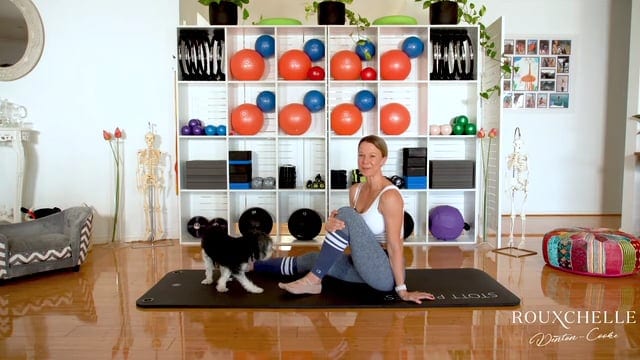
Home practice as it actually looks — including the audience.
How to close the feedback gap at home
The video can’t see you, so borrow its eyes back.
Repeat your classes. Don’t treat the library like a menu to eat through. Take the same class four or five times — the first time you follow, the third time you refine, the fifth time you own it. Repetition is where technique lands, and it’s the single biggest correction for training without a teacher.
Check yourself once a week. Prop your phone against a wall and film one class, or work side-on to a mirror. You’ll spot the flared ribs and the shrugged shoulders yourself — most people can, once they actually look.
Slow everything down. Speed hides faults; tempo exposes them. If you’re unsure whether you’re doing an exercise well, do it at half speed and the answer will introduce itself.
Get real eyes on you occasionally. A teacher who can actually see you catches what self-checking misses — and this matters enough that we offer it directly: live sessions over Zoom, private or small group, arranged by request. Same library, same method, but I’m on the other end of the camera watching your ribs and your shoulders, not a recording. Once a month or every six weeks is enough to keep your technique honest between the videos. Online versus studio isn’t a war you have to pick a side in — the strongest pattern I know is home for frequency, a teacher’s eyes for accuracy.
When online alone isn’t the right tool
If you’re working with pain, an injury, or symptoms — leaking, prolapse, a back that complains — you need assessment before a video library, not instead of one. The same goes for pregnancy: classes need to be built for it, not merely gentle, and I’ve written about what that actually means. And if you’re managing a condition that changes your energy day to day — an underactive thyroid, menopause — online works beautifully precisely because it scales, but the scaling advice in those articles comes first.
A video library is a tool. It’s a very good tool for building a consistent, skilful practice around a real life. It is not a diagnosis, a rehab plan, or a substitute for the one appointment that tells you what your body actually needs.
Common questions
Is online Pilates as effective as studio classes?
For general strength, mood and quality of life in healthy adults, the trial evidence says the results are similar when the training is consistent. What the studio still does better is correct your technique — so close that gap deliberately: repeat classes, film yourself, and get a teacher’s eyes on you now and then. If you’re training with us, a live Zoom session — private or group, by request — is exactly what that check-in is for.
Do I need equipment to start at home?
No. A mat and floor space is enough. A resistance band, a small ball and light weights add variety and load later — all together costing less than a month of studio classes.
How many online sessions a week do I need?
Two holds what you have; three is where change starts. The trial that found online matched face-to-face used three sessions a week. Short and regular beats long and occasional, every time.
How do I know if I’m doing it right without a teacher?
Slow down, and film one session a week. If something consistently pinches or hurts — as opposed to working hard — stop and get assessed. Effort should feel like effort, never like a warning.
Try it against your own week
Don’t take my word or the trial’s — run the experiment on yourself. Pick three classes from the library, put them in your calendar for next week, and see whether they actually happen more easily than the studio schedule ever did. That’s the whole question online Pilates answers.
Start with ROUX On Demand — the trial week costs $1 AUD, which is what a fair experiment should cost: enough to sign up, not enough to sway the result. Filter by level and length, begin with a beginner mat class, and repeat it until it’s yours.
About the author
Rouxchelle Denton-Cooke is the founder of ROUX Wellness and the teaching expertise behind The Method by ROUX, with over twenty years in the fitness industry. She is a fully certified instructor and educator across Mat, Reformer, Cadillac, Chair and Barrels, and Injuries and Special Populations, and also teaches fascial movement, HIIT-style Halo training and barre, with a specialisation in pre- and postnatal work. She has written education programs for well-known brands in the fitness industry, and teaches both clients and the instructors who go on to teach.
This article is general information. Anything involving pain, injury, pregnancy or a medical condition should be assessed by an appropriate professional before you train — online or anywhere else.