
Blog Post
Pilates for Menopause: What It Helps, and What It Doesn’t
I’m forty-nine, and I’ve been through menopause.
I mention that at the start because I’ve read a great many articles about menopause and movement, and most of them were written by people who haven’t. They’re warm. They’re encouraging. And they quietly promise things that movement cannot deliver.
I’ve taught Pilates for over twenty years. I’ve spent a lot of that time with women in this exact season, and I’ve now been in it myself. So this is the honest version: what Pilates genuinely helps with during and after menopause, what it doesn’t touch at all, and what you’ll need alongside it.
What’s actually changing
Menopause isn’t one event. It’s the drop in oestrogen and the years of adjustment either side of it — and oestrogen was doing far more work than most of us were ever told.
It was helping maintain bone density. Bone loss accelerates sharply in the years around the final period, which is why fracture risk climbs from midlife onwards. It was influencing how you hold muscle mass, which is why strength can slip away even when nothing about your routine has changed. And it plays a part in sleep, in mood, and in how your joints feel at six in the morning.
None of that is a failure of willpower. It’s a physiological shift, and it responds to the right inputs.
Let’s be honest about hot flushes
Here’s the part most Pilates articles avoid, and the part I most want you to read.
The Australasian Menopause Society, in its lifestyle guidance for healthy ageing, states it plainly: exercise does not reduce vasomotor symptoms. Hot flushes and night sweats are not something you can move your way out of.
I wish that weren’t true. I went through it myself, and no amount of movement is the lever for this one.
It matters that you know this before you start, because the alternative is worse. If you take up Pilates expecting the flushes to settle and they don’t, you’ll reasonably conclude the movement isn’t working and stop — right when it’s beginning to work on everything else.
If vasomotor symptoms are what’s making your life difficult, that’s a conversation for your GP or a menopause specialist, and there are effective options. Movement is not one of them, and any teacher who tells you otherwise is guessing.
So what does Pilates actually help with?
Quite a lot, as it turns out, and there’s reasonable evidence behind it.
A 2024 review pooled eleven randomised controlled trials of Pilates in postmenopausal women. The researchers tracked nine areas of everyday life — pain, how easily women moved, how much their health held them back, how their mood affected what they got done, how much they saw other people. Pilates improved five of the nine.
The two biggest changes were the most practical ones: less pain, and moving more easily.
Two things from that review are worth knowing before you begin. The women who stayed with it for 48 sessions or more improved in eight of the nine areas. Those who did fewer improved in three. And Pilates on equipment — reformer, chair, barrels — beat mat work, seven areas against three.
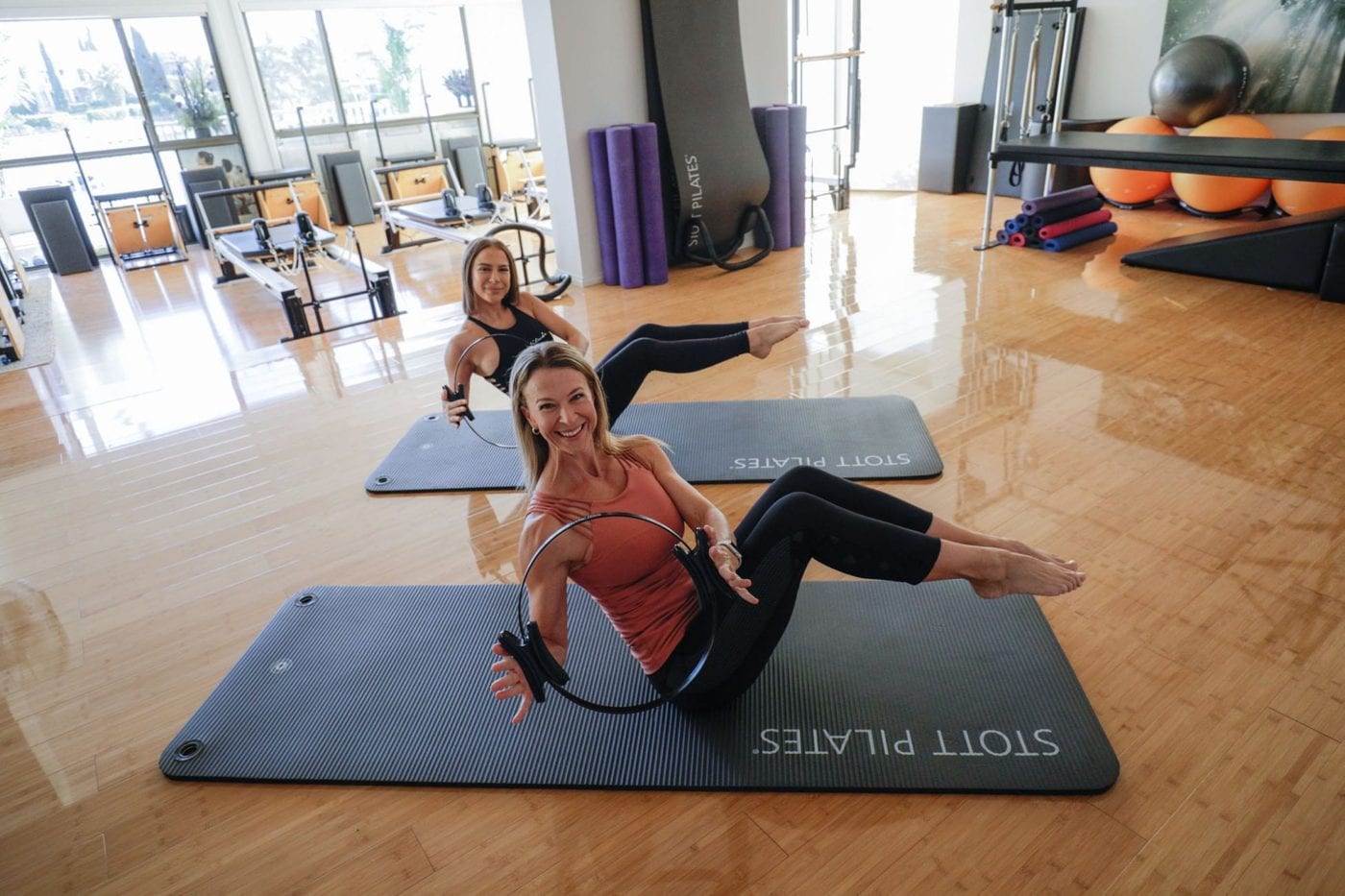
That doesn’t make mat work pointless. It means the results come from load and from staying with it, not from a fortnight of gentle stretching. It also matches what I’ve watched happen in the studio for twenty years: the women who change are the ones who are still there in month six.
The reviewers were careful to note that none of their analyses reached high certainty of evidence, and I’ll be equally careful. This is promising and consistent and worth acting on. It isn’t settled science.
Strength and balance, which matter more than they sound
Balance work is the least glamorous item on this list and quite possibly the most valuable. Falls are the main route to fragility fractures, and the AMS is direct that exercise improves balance and reduces the risk of falling and fracture.
Pilates is unusually good at this, because so much of it is single-leg, off-centre, and asking you to control your body through a range rather than simply get through a repetition. That’s precisely the quality that keeps you upright when a footpath surprises you.
The parts I’d be careful about
You’ll see Pilates recommended for menopausal sleep, anxiety and mood. Some trials do report improvements. But sleep and mood improve with almost any regular exercise, in almost any population, and it’s very hard to separate the effect of the Pilates from the effect of having a routine, an hour to yourself, and a room full of people in the same season of life.
I think that’s still worth having. I don’t think it should be sold as something only Pilates can do.

Where Pilates isn’t enough
This is the part I’d rather you heard from me than found out later.
If your priority is bone density, Pilates on its own is not the strongest tool. A network meta-analysis of 49 studies and 3,360 postmenopausal women compared eight forms of exercise for their effect on bone mineral density. The clear winner at both the lumbar spine and the femoral neck was aerobic exercise combined with resistance training. Resistance training alone ranked third at both sites.
Bone responds to being loaded — properly loaded, progressively, over time. A good deal of Pilates loads you well, particularly on the equipment. But a mat class three times a week is not a bone-density program, and I’m not going to pretend to you that it is.
The Australasian Menopause Society recommends 150 to 300 minutes of moderate activity a week, built from three ingredients: aerobic work, strength work and flexibility. Pilates sits most naturally in the strength and flexibility columns and does a genuinely good job there. It does not replace walking, and it does not replace lifting something heavy.
Telling you that costs me a sale. I’d rather you had strong bones.
What a realistic week looks like
If you took the guidelines seriously and built a week around them, it would look something like this.
Two to three Pilates sessions, ideally with some resistance — reformer, bands, or weights added to mat work. Two or three walks brisk enough that talking takes a bit of effort. One session where you lift something meaningfully heavy for your body. And genuine rest, because recovery at fifty is not what it was at thirty, and training through exhaustion is how people get hurt.
That’s roughly four to five hours across an entire week. It’s not a small commitment. It’s also nowhere near the two hours a day the internet sometimes implies.
Start with what you’ll actually do. Two twenty-minute sessions a week that happen will beat five hour-long sessions that don’t, every single time.
Common questions
How long before I notice anything?
Most people feel steadier and less stiff within three or four weeks. The measurable quality-of-life changes in the research came from longer programs — 48 sessions and up, so roughly four to six months at twice a week. Bone changes are slower again, and measured in years.
Is mat Pilates enough, or do I need a reformer?
Mat work is a legitimate place to start and perfectly fine if it’s what you have access to. But the evidence favours equipment, and the reason is load. If you’re working at home, adding resistance bands and light weights to mat work moves you meaningfully closer to the equipment effect.
Can Pilates help with pelvic floor changes?
It can contribute, and well-taught Pilates should include breath and pelvic floor coordination rather than just telling you to “engage”. But if you’re experiencing leaking, urgency or heaviness, see a pelvic health physiotherapist first. That’s an assessment, not a class.
I’ve never done Pilates and I’m 54. Is it too late?
No. The trials behind everything above were run on postmenopausal women, a great many of them complete beginners. Starting later means starting more carefully. It doesn’t mean starting less.
Where to begin
If you’d like to start at home, our on-demand library has classes from beginner upwards, filtered by level and by equipment, so you can begin with a mat and add load as you get stronger.
And if this has made you curious about the anatomy underneath it all — why load matters, how the pelvic floor actually works, what’s happening inside a joint that aches — that’s what we teach in The Method by ROUX.
You may also find our pieces on Pilates through pregnancy and early motherhood and training with an underactive thyroid useful. Both deal with the same question: how do you train a body whose rules have changed?
About the author
Rouxchelle Denton-Cooke is the founder of ROUX Wellness and the teaching expertise behind The Method by ROUX, with over twenty years in the fitness industry. She is a fully certified instructor and educator across Mat, Reformer, Cadillac, Chair and Barrels, and Injuries and Special Populations, and also teaches fascial movement, HIIT-style Halo training and barre, with a specialisation in pre- and postnatal work. She has written education programs for well-known brands in the fitness industry, and teaches both clients and the instructors who go on to teach.
This article is general information, not medical advice. Menopause affects everyone differently, and anything involving symptoms, medication or pelvic health should be discussed with your GP, a menopause specialist or a pelvic health physiotherapist.