
Blog Post
Pilates Through Pregnancy and After Birth: What Changes, and What Shouldn’t
I’ve taught pre- and postnatal Pilates for most of my career, and there are two conversations I have over and over.
The first is with a woman who has just found out she’s pregnant and wants to know if she has to stop. The second is with a woman about six weeks past giving birth who has been told she’s “cleared” and wants to know why nothing feels like it used to.
Neither of them is asking whether Pilates is good for them. They both already believe it is, and they’re right. What they actually need to know is what changes — and that’s the part most articles skip, because “Pilates is wonderful in pregnancy!” is easier to write than the specifics.
So here are the specifics.
What the guidelines actually ask for
The Royal Australian and New Zealand College of Obstetricians and Gynaecologists recommends 150 to 300 minutes of moderate activity a week during pregnancy, spread across most days, plus two resistance sessions a week on non-consecutive days.
Moderate has a useful definition: you can still hold a conversation. If you’re too breathless to finish a sentence, you’ve gone past it.
For resistance, if you’re new to it, the guidance is one to two sets of twelve to fifteen repetitions, using light weights, resistance bands or your own body weight, moving slowly and breathing throughout. Not heavy. Not held.
Pilates sits neatly inside that resistance column, and it’s one of the few forms of it that also trains the pelvic floor, the deep abdominals and your breathing at the same time. That’s the genuine case for it — not that it’s gentle, but that it covers several requirements at once.
The thing most prenatal Pilates gets wrong
Here’s the specific I most want you to have.
RANZCOG advises against exercising lying flat on your back for prolonged periods after the first trimester.
Now think about what a standard mat Pilates class is. The hundred. Single leg stretch. Double leg stretch. Criss-cross. Roll-up. The bulk of the classical mat repertoire happens supine, and a great deal of it happens supine for a long stretch at a time.
Which means a genuine prenatal class isn’t a normal class taken gently. It’s a differently built class — more side-lying, more seated, more standing, more four-point kneeling, and the supine work either shortened, propped into an incline, or replaced.
If you’re in a class from the second trimester onwards and you’re spending most of it flat on your back, that class has not been adapted for you, whatever it’s called. That’s worth knowing, because “prenatal” isn’t a protected term and plenty of classes carry the label without carrying the redesign.
The other things the guidance asks you to leave out: heavy lifting, isometric holds, walking lunges, jumping and bouncing, and anything with a real risk of falling. Running too, if you weren’t already a runner before you were pregnant.
The strongest evidence in this whole article
If you read nothing else, read this paragraph.
Pelvic floor muscle training, done during and after pregnancy, prevents stress urinary incontinence. The Australian Physiotherapy Association describes this as a grade A recommendation based on level 1 evidence — which, in a field where most exercise advice rests on far shakier ground, is about as strong as it gets.
For context: up to one in three women who have had babies experience urinary leakage, and around one in four develops a prolapse.
Common, then. But common is not the same as normal, and it is emphatically not the same as permanent. This is the one thing in pregnancy and postnatal movement where the evidence says clearly: do this, and it works.
Which makes it worth being precise about what “this” actually means — because the usual advice is not quite right.
The pelvic floor is not a zip
Almost every woman I meet has been given the same instruction. Zip up. Lift. Hold.
That’s one action. The pelvic floor has a repertoire, and training only the lift is like training only the upward half of a bicep curl and calling it strength.
Here’s what’s actually happening. Your pelvic floor works with your breath, as part of what’s sometimes described as a piston. As you inhale, your diaphragm descends and your pelvic floor lengthens and broadens downwards a little. As you exhale, it recoils and lifts. That downward lengthening is not a fault or a weakness — it’s normal, healthy function, and it’s the half nobody teaches.
So the pelvic floor can be trained inside ordinary movement, without being cued separately at all.
Take a squat. As you lower, the pelvic floor lengthens under load — that’s eccentric work, the muscle working while getting longer. As you stand, it shortens — concentric. Pair the descent with an inhale and the return with an exhale, and the breath and the movement are asking for the same thing at the same time. No zipping required. The squat does the teaching.
That’s a more useful way to train it than a hundred isolated lifts, and it’s closer to how the pelvic floor has to behave in real life — reflexively, in coordination, under load, while you’re busy doing something else.
Why this matters enormously for birth
During a vaginal birth, the pelvic floor stretches up to 200 per cent of its resting length.
Read that again, and then consider what we’ve been telling pregnant women to do: grip, lift, hold, repeat.
A pelvic floor trained only to contract, and never to lengthen with control, is not well prepared for the single biggest lengthening task it will ever face. The Pilates Alliance Australasia puts it plainly — over-strengthening without learning to release may make a vaginal birth longer, harder, or in some cases not possible. A woman who can already contract and hold needs, above all, to learn how to let go.
So what you want is a modulated pelvic floor. One that can contract quickly when you sneeze. One that can hold while you carry something up a flight of stairs. One that can lengthen slowly and with control. And one that can fully, genuinely release.
Four different demands. “Do your Kegels” trains one of them.
Please do not walk around holding it in
I want to be as clear as I can here, because this is where the standard advice does real harm.
You should not be zipping your pelvic floor all day. Not while you walk, not while you drive, not while you sit at your desk. A muscle held permanently switched on doesn’t become strong — it becomes overactive, and an overactive pelvic floor is its own problem, with its own symptoms: pelvic pain, pain during sex, difficulty emptying your bladder or bowel, constipation, urgency.
And here is the part that catches people out. An overactive pelvic floor can leak too. A muscle that is already at the end of its range, gripping, has nothing left to give when you sneeze.
Which means the most common reaction to leaking — squeeze harder, more often — is exactly the wrong treatment for a meaningful number of women. They do more, it gets worse, and they conclude their body is broken. It isn’t. The exercise was wrong for the problem.
So: leaking does not automatically mean weak. It means get assessed. You cannot tell from the internet which of these you are, and neither can I. That is precisely what a pelvic health physiotherapist is for, and it takes one appointment to find out.
A well-trained pelvic floor is responsive, not permanently braced. It should be able to do its job and then get out of the way.
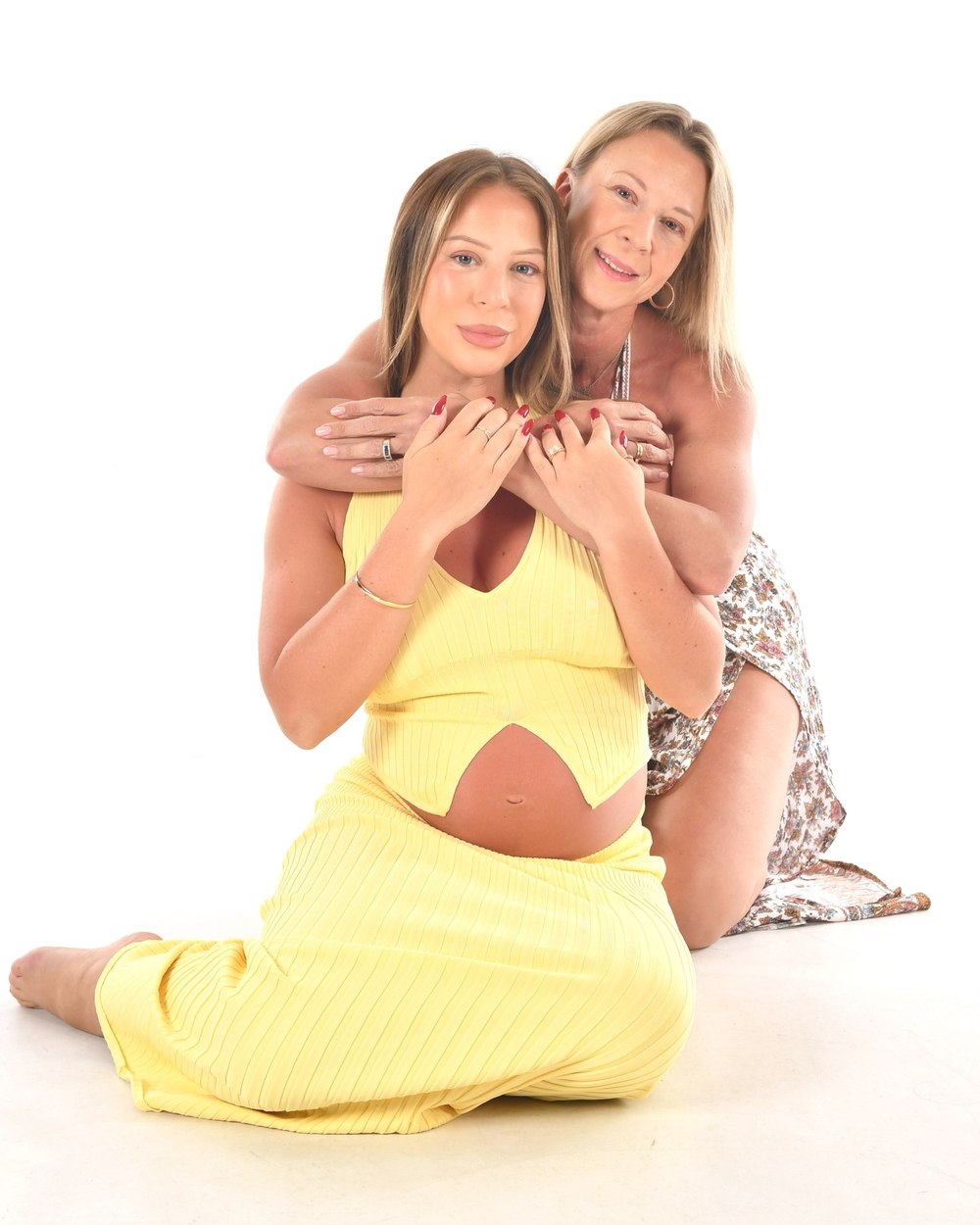
With my daughter, during her first pregnancy.
What Pilates genuinely helps with while you’re pregnant
Back and pelvic pain. More than half of pregnant women get lower back pain, and the APA is clear that regular exercise both treats and prevents it — naming abdominal strengthening, pelvic floor training and targeted stretching. But “abdominal strengthening” needs translating, because in pregnancy it does not mean crunches. The guidance itself has already taken most crunch-shaped work off the table — no prolonged lying on your back after the first trimester, no breath-holding, no straining — and your midline is busy stretching to make room for a baby. Loading it into flexion is the wrong tool for this season. What it means is the deep layer, trained the way this article has already described: with the breath, alongside the pelvic floor, in positions that still work at eight months.
In my own programming, the muscles that do the most for a pregnant back aren’t on the front of the body at all. As the bump grows and pulls the pelvis forward, it’s the posterior chain — glutes, hamstrings and the muscles of the back — that keeps the pelvis stable and the posture tall. Squats and their relatives train exactly that, and they bring back the breath pattern from earlier: inhale on the way down as the pelvic floor lengthens, exhale on the way up as it lifts. Strong legs are also, not incidentally, the endurance the labour room actually asks for. Add gentle spinal mobility to keep a stiffening back moving, and arm and upper-back strength for the year of carrying that’s coming, and you have what a well-built prenatal session actually looks like.
Staying strong for what’s coming. Labour is physical, and so is the year afterwards. Carrying a baby, a capsule, a pram and a bag of shopping is a strength task, and it arrives whether or not you’ve trained for it.
Sleep and mood, which the guidelines also list among the benefits — worth having in a season when both are under pressure.
There’s also emerging evidence around exercise reducing the risk of gestational diabetes and pre-eclampsia. RANZCOG is careful to call it emerging rather than settled, and so am I.
Why the six-week check isn’t a green light
This is the part I most want the second woman to hear.
The six-week appointment checks that you are healing. It is not an assessment of whether your pelvic floor and abdominal wall are ready to be loaded, and it very rarely includes one.
The Australian Physiotherapy Association recommends every mother receive an individualised pelvic health assessment at six to twelve weeks postnatally, specifically to evaluate abdominal and pelvic floor function. That is a different appointment, with a different practitioner, and most women are never told it exists.
Two more numbers worth carrying. Recovery is generally maximised at four to six months postnatally — not six weeks. And the recommendation is to wait at least three months before returning to running, starting instead with walking and other low-impact work.
None of that means doing nothing. It means the first months are for rebuilding the foundation — breath, pelvic floor, deep abdominals, gentle load through the hips and back — rather than for proving you can still do what you did before. Pilates is unusually well suited to that stretch, because it starts at exactly that layer.
If you’re leaking, heavy, or something feels wrong
See a pelvic health physiotherapist. Not eventually — as the next thing you do.
I’m a Pilates educator with a pre- and postnatal specialisation, and this is the clearest line in my practice: leaking, urgency, a feeling of heaviness or dragging, or a gap down your midline that doesn’t seem to close needs assessing by someone qualified to assess it. A good class can support what a physio finds. It cannot replace the finding.
Any teacher who tells you to just push through is not a teacher you should stay with.
Common questions
Can I start Pilates while pregnant if I’ve never done it?
Yes, with a class built for pregnancy and a teacher who knows you’re pregnant. Beginning something new in pregnancy is fine; beginning something unmodified is not.
How soon can I do Pilates after birth?
Gentle breath and pelvic floor work can usually begin in the early weeks, and many women are given this by their midwife. Loaded work waits for a pelvic health assessment at six to twelve weeks. If you had a caesarean or a difficult birth, that timeline is yours and your practitioner’s to set, not the internet’s.
Do I have to stop the exercises I love?
Some of them, for a while. The classical mat repertoire is largely supine, and that changes after the first trimester. A good teacher swaps rather than subtracts — you’ll still work hard, just differently.
Can I train my abs while pregnant?
Not the crunch kind. Some degree of abdominal separation happens in almost every pregnancy — it’s the wall making room, not an injury — and the evidence doesn’t show that sensible exercise causes it. But loading your midline into flexion while it’s stretching is the wrong tool for the season. The version that belongs in pregnancy is the deep layer, trained with the breath alongside the pelvic floor. And if an exercise makes your midline dome or bulge, that’s your cue to swap it, not push through.
Is it too late to start pelvic floor training if I’m already leaking?
No. The evidence supports pelvic floor muscle training both during and after pregnancy. But get assessed before you start squeezing, because leaking does not always mean weakness — an overactive pelvic floor leaks too, and for those women more gripping makes it worse. The right exercise depends entirely on what’s actually going on.
Should I be holding my pelvic floor in during the day?
No. A muscle held on permanently becomes overactive rather than strong, and that brings its own problems — pelvic pain, pain with sex, difficulty emptying, urgency. You want a pelvic floor that responds when it’s needed and releases when it isn’t.
Where to begin
Our on-demand library has a prenatal filter, so you can find work that’s already been built for this season rather than adapting on the fly.
And if you want to understand what’s happening underneath — how the pelvic floor and the deep abdominals actually work together, and why load matters — that’s what we teach in The Method by ROUX.
You may also find Pilates for Menopause useful further down the track. It deals with the same question in a different season: how do you train a body whose rules have changed?
About the author
Rouxchelle Denton-Cooke is the founder of ROUX Wellness and the teaching expertise behind The Method by ROUX, with over twenty years in the fitness industry. She is a fully certified instructor and educator across Mat, Reformer, Cadillac, Chair and Barrels, and Injuries and Special Populations, and also teaches fascial movement, HIIT-style Halo training and barre, with a specialisation in pre- and postnatal work. She has written education programs for well-known brands in the fitness industry, and teaches both clients and the instructors who go on to teach.
This article is general information, not medical advice. Every pregnancy and every birth is different, and anything involving symptoms, pain, bleeding or pelvic floor function should be discussed with your GP, midwife, obstetrician or a pelvic health physiotherapist.